What’s the Difference Between Net Metering and Gross Metering?
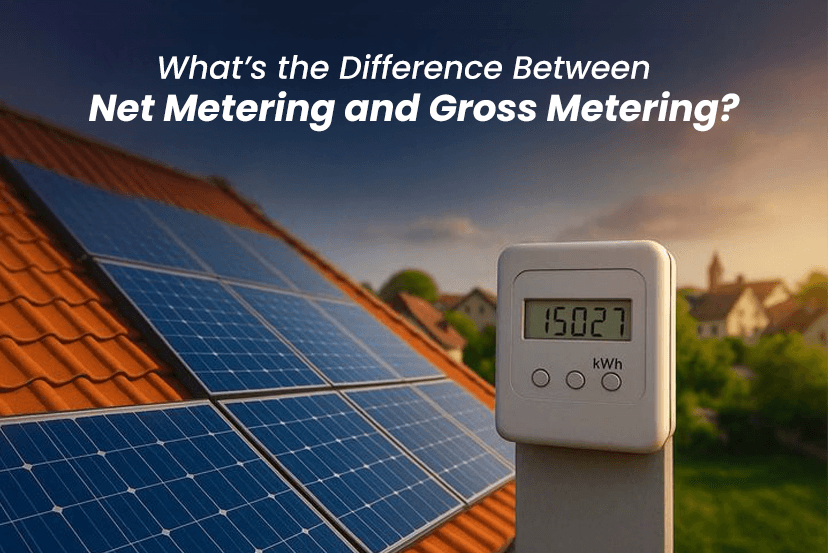
If you are installing a rooftop solar system for your home, you must have heard the terms net metering and gross metering multiple times. But do you know what these actually mean? Well, installing a rooftop solar system can help reduce electricity bills, but the savings also depend on how the electricity generated by your solar panels is used, right? That is where net metering and gross metering come into play.
Both basically connect your rooftop solar system to the electricity grid. But it can absolutely work differently. Understanding gross metering and net metering really matters to you if you're installing rooftop solar. Let us help you understand how both systems work and what you should consider before choosing one.
What Is Net Metering in Solar?
Net metering is a billing arrangement. Under this, electricity generated by your rooftop solar panels is first used to meet your property’s electricity needs. If your system generates more electricity than you consume, the extra units are sent to the electricity grid.
A bidirectional meter records the electricity you take from the grid and the electricity you send back. The DISCOM (Distribution Company) adjusts these units according to the applicable rules while calculating your electricity bill.
Let’s understand this with an example-
Suppose your solar system generates 500 units in a month. While your property consumes only 400 units.
- Solar electricity generated: 500 units
- Electricity consumed: 400 units
- Excess electricity: 100 units
So, understand that the extra 100 units are exported to the grid and adjusted according to the applicable net metering regulations.
In simple: Net metering helps you use solar electricity for your own needs and reduce the electricity you purchase from the DISCOM.
What Is Gross Metering?
Gross metering is the billing arrangement in which the entire electricity generated by your rooftop solar system is supplied to the electricity grid. That means, you do not directly use the generated solar electricity to offset your property’s consumption. Instead, the DISCOM accounts for the total solar electricity supplied to the grid and pays you according to the applicable feed-in tariff.
Let’s understand with an example,
Suppose your solar system generates 500 units in a month, and the applicable feed-in tariff is Rs. 3 per unit. So-
- Total solar electricity generated: 500 units
- Electricity supplied to the grid: 500 units
- Payment received: Rs. 1500.
Your property’s electricity consumption is billed separately by the DISCOM.
In Simple: Gross metering allows you to sell all the electricity that your solar system generates to the DISCOM and receive payment at the applicable rate.
Difference Between Net Metering and Gross Metering
Let’s understand the factors that make net metering and gross metering different from each.
Comparison | Net Metering | Gross Metering |
Electricity usage | Solar power is used for your own consumption first. | All solar power is directly supplied to the grid. |
Excess electricity | Extra units are exported to the grid. | Entire solar generation is exported. |
Metering | A bidirectional meter (commonly) | Measures solar generation and electricity consumption separately. |
Billing | Imported and exported units are adjusted | Solar generation and electricity consumption are billed separately. |
Payment | Exported units are adjusted as per applicable rules | Payment is based on the applicable feed-in tariff. |
Main benefits | Helps reduce electricity bills | Allows you to earn from solar electricity generation. |
Which Is Better: Net Metering or Gross Metering?
The right option depends on your electricity consumption, solar generation and the tariff offered by your DISCOM.
Net Metering-
- If you have regular electricity consumption
- If you want to reduce your monthly electricity bills
- If you want to use the electricity generated by your solar panels
- If your property is eligible under the applicable net metering regulations.
Gross Metering-
- If you want to sell your entire solar electricity generation.
- If the applicable feed-in tariff offers suitable returns.
- If you want solar generation and electricity consumption to be accounted for separately.
- If your DISCOM allows gross metering for your consumer category.
IMPORTANT-
Compare the electricity tariff you pay with the feed-in tariff you receive before choosing any of the options. Additionally, check the latest state regulations, as both arrangements may have different eligibility conditions.
Feed-in Tariff (Feed-in tariff is the price that is paid for each unit of solar electricity supplied to the grid. It helps solar system owners understand how much they can earn from the electricity they generate and export.)
How to Apply for Net Metering in India?
If you want to install a rooftop solar system with net metering, you need to apply through your local DISCOM or the applicable government portal. It involves steps like-
STEP 1
Review your electricity connection, sanctioned load and permitted solar capacity.
STEP 2
You can apply through your DISCOM’s official rooftop solar portal. Eligible residential consumers can also use the PM Surya Ghar.
STEP 3
Next, the DISCOM checks whether the electricity network can support your proposed solar system.
STEP 4
Once your application is approved by the DISCOM, you can complete the installation.
STEP 5
Inspection and meter installation are another step; the DISCOM verifies the system and arranges the required meter.
STEP 6
Lastly, complete the agreement and commissioning formalities before starting grid connected operation.
To get net metering, you may require several documents, including:
- Latest electricity bills
- Consumer number
- Identity and address proof
- Solar system specifications and other documents
(These document requirements may vary depending on the DISCOM)
NOTE: The exact application process and eligibility conditions vary by state and DISCOM. So make sure to check the latest updates accordingly.
Learn more about DISCOM through this guide: https://moglixsolar.com/blogs/what-are-the-rules-for-rooftop-solar-and-the-discom-process-complete-guide
Final Words
Many users get confused between net metering and gross metering when it comes to installing solar panels. If you are one of those, this guide explains everything in simple terms to you. Net metering helps to reduce electricity bills by adjusting solar generation against grid consumption. On the other hand, gross metering allows you to sell your entire solar electricity generation to the DISCOM.
If you want to get assist about the process, or wants get rooftop solar installation, then Solar Moglix would be your right spot. On our platform, you can get top-notch and experienced technicians who perform solar installation. Get more information about us by reaching out to us today!
Frequently Asked Questions (FAQs)
Q. What is the main difference between net metering and gross metering?
Ans. Net metering uses solar electricity for your own consumption and adjusts excess units against grid electricity.
Gross metering sends all the generated solar electricity to the grid in exchange for payment at the applicable tariff.
Q. Is net metering better than gross metering?
Ans. If you want to reduce electricity bills, then Net metering would be the right choice for you. Whereas, if you want to sell your entire solar generation, then gross metering would be suitable for you. The complete choice depends on electricity consumption, tariff, and state regulations.
Q. Can commercial buildings use net metering?
Ans. Yes, commercial buildings may be eligible for net metering.
Q. Does net metering eliminate electricity bills?
Ans. No. It can reduce your electricity charges