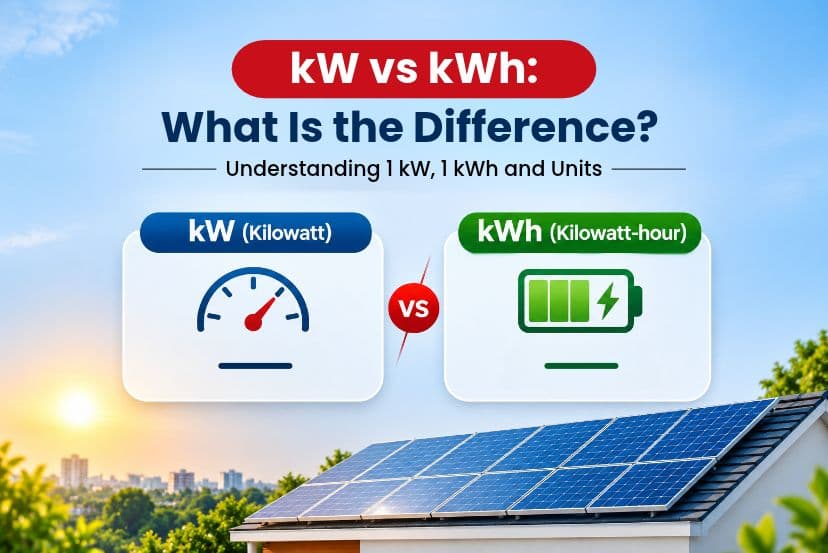
kW vs kWh: What Is the Difference? Understanding 1 kW, 1 kWh and Units
When you check electricity bill, compare appliances, or planning a solar installation, then you have must seen the terms like kW, kWh and units. These term mostly look similar that makes it slight confusing. But kW and kWh are used to measure different things.
One of the easy way to understand is kW measure power, while kWh measure energy that is used or generated over time.
Still, a common question arises: What is kW? What is kWh? What is the difference between kW and kWh? And so on. We will understand everything in this guide, so let’s get into it.
What Is kW?
kW fullform is Kilowatt that is unit of power.
One kilowatt is equal to:-
1 kW = 1,000 watts.
The power tells you how much electrical power an appliance, machine, inverter or solar system can use or produce at a given moment.
For example-
- 1,000 watt appliance= 1 kW
- 2,000 watt appliance= 2 kW
Simply, when you see kW, consider power or capacity.
What Is kWh?
The full form of kWh is Kilowatt-hour. It is a unit of energy. This basically conveys the power being used or produced, and how much energy has been used or produced over a period of time.
For example-
1 kW × 1 hour = 1 kWh
So, if a 1 kW appliance runs for one hour, it uses 1 kWh of energy.
What is the Difference: kW vs kWh?
Here are the major differences between kW and kWh in simple terms-
kW (Kilowatt) | kWh (Kilowatt hour) |
Measure power | Measure energy |
kW shows the rate of power use or production | kWh shows the amount of energy used or produced over time |
1 kW = 1,000 watts | 1 kWh = 1 kW used for 1 hour |
This is used for appliance ratings and system capacity | This is used for electricity consumption and generation. |
kW alone does not tell you how much electricity was used. | 1 kWh = 1 unit of electricity. |
How Many Units Are in 1 kW and 1 kWh?
Most users get confused about the units in 1 kWh or in 1 kW.
Units in kW
Well, there is no fixed number of units in 1 kW. Because kW measures power, not energy consumption. To calculate the number of units, you also need to know the operating time.
So the simple formula is-
Energy consumer (kWh) = Power (kW) × Time (Hours)
For Example-
1 kW × 1 hour = 1 kWh = 1 Unit
Therefore,
- 1 kW used for 1 hour = 1 unit
- 1 kW used for 5 hours = 5 units.
How Many Units Are in 1 kWh?
This one is easier. Let’s understand
1 kWh = 1 unit of electricity.
There is no additional calculation required. By the number of kWh, you will be able to get units.
So, next time you search how many units are in 1 kWh, then it simply means 1 unit.
How to Calculate Electricity Consumption in kWh or Units
There is a simple method to calculate electricity consumption in kWh or units. You can calculate it using-
kWh = kW × Hours Used
Since 1 kWh = 1 Unit, the result in kWh is also the number of units consumed.
Let's understand this with an example-
Suppose a 1.5 kW appliance runs for 4 hours a day.
1.5 kW × 4 hours = 6 kWh.
Therefore, it consumes:
6 kWh = 6 Units per day.
If this operates for 30 days, then-
6 × 30 = 180 kWh.
Now, the estimated consumption would be- 180 units per month.
What’s kW and kWh on Your Electricity Bill?
On an electricity bill, the units consumed are generally expressed in terms of kWh.
Example-
If your bill shows:
- Previous reading: 1,250 units
- Current reading: 1,430 units
- So, the difference would be 1,430 - 1,250 = 180 units.
It means the electricity consumption for that billing period was 180 kWh.
NOTE:
Electricity bill includes multiple factors to make the total bill amount which can be fixed charges, taxes, fuel adjustment or other applicable charges.
Why kW and kWh Matter When Choosing Solar?
If you are planning a solar installation, then it is important to understand kW and kWh terms. This will allow you to ask the right installation questions.
- If someone tells you, “You need a 5 kW solar system.”
- In this, 5 kW refers to the system’s capacity.
Let’s take another scenario,
- If someone tells you, “The system generated 20 kW today”
- So, it means it generated 20 units of electricity during that period.
IMPORTANT:
Therefore, when comparing solar proposals, don’t confuse:
System Capacity (kW) with energy generation (kWh).
Final Words
Do you also get confused about kW or kWh? Then, let us clarify it for you simply. kW measures power and kWh measures energy. The most important relationship is 1 kW × 1 hour = 1 kW = 1 unit of electricity.
If you are checking an appliance, kW tells you its power requirement, whereas for electricity consumption or solar generation, kWh tells you how much energy was used or produced. When installing solar for a home, commercial space or any other area, it is really important for you to understand the difference and meaning of each. However, if you are planning for solar installation but couldn’t find a trusted solar partner. Then Moglix Solar is right here, trusted by many indian homeowners and businesses for our solar installation, solar financing and other services. Want to explore more? Connect with us today at +91-9811366559.