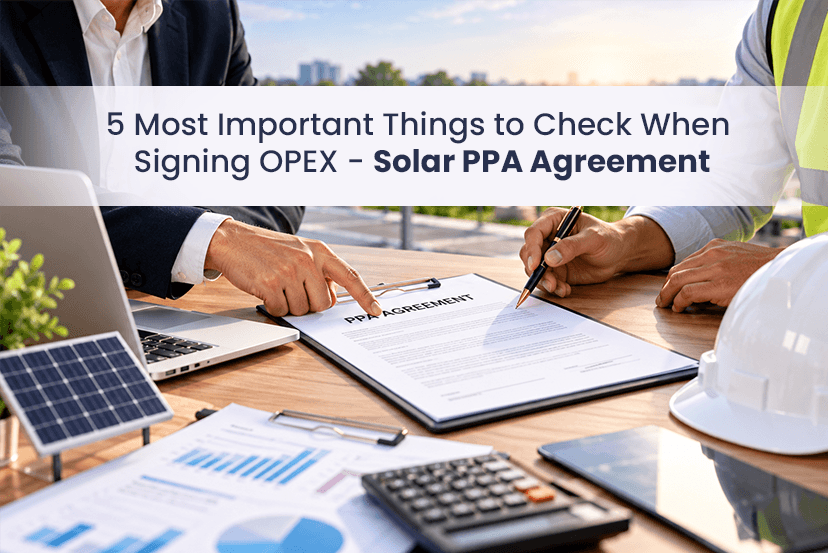
5 Most Important Things to Check When Signing an OPEX - Solar PPA Agreement
Are you planning to switch to solar to reduce electricity costs without spending a large amount on installing a solar power system? Well, it’s really crucial to select the right financing model and understand the agreement, payment terms, and responsibilities involved.
Especially if you are opting for an OPEX solar financing option. In this agreement, a solar developer invests in the system, manages its installation, and supplies electricity to the business at an agreed rate. When signing the Solar PPA agreement, it is important to review several crucial factors that we will discuss in this guide. So let's get into it!
5 Important Things to Check Before Signing an OPEX Solar PPA
Power Purchase Agreement (PPA) is a contract between a power producer and a buyer. In this contract, it sets out the terms for purchasing electricity.
The following are the crucial factors that are vital to check before signing an OPEX solar PPA-
1. Electricity Tariff and Payment Terms
Read the contract carefully, and start by understanding the tariff part in the PPA agreement. Find the “Electricity Tariff and Payment Terms,” which simply means how much you will pay for solar electricity.
It is crucial to compare the complete cost of different providers instead of sticking to the only quoted rate. Usually, with a low tariff, you will be able to save money efficiently.
To ensure everything related to the payment and tariff, check the following points-
Price Per Unit
Look for the section that mentions the price per unit. In this, you should check and confirm the tariff charged for each unit of solar electricity that is consumed or supplied.
Tariff Escalation
Now pay attention to whether the rate will increase annually or at specific intervals.
Minimum Payment Commitments
Next, you need to understand or discuss whether you need to pay a minimum amount even when solar generation or consumption is lower than expected.
Additional Charges
Pay extra attention to additional charges if mentioned. These charges could be applicable taxes, metering costs, grid related charges or other fees.
Billing Terms
Understand the billing pattern before signing the OPEX solar PPA agreements. In this, you have to confirm the billing terms, cycle, payment deadline and penalties for late payment. This will help to avoid confusion later on.
IMPORTANT: Compare the proposed solar tariff with your current electricity cost, including relevant charges.
2. Contract Duration and Exit Conditions
The next section in the PPA agreement that is worth paying attention to before finalizing or signing the contract is “Duration and Exit Conditions.”
The PPA agreement continues for several years, which makes it more important to understand what happens if your business needs to change its plans.
Along with the contract period, renewal conditions, and termination clause, check these factors-
Contract Length
It should clearly mention the exact start and end dates of the agreement.
Early Termination
Check if you want to exit the contract before its expiry and what charges may apply.
Business Relocation
In case of relocation, when your factory, warehouse or office moves to another location, what would happen? Check this in your contract.
Ownership at the End of the Contract
At the end period of the contract period, what are the rules or regulations? Confirm this with your OPEX provider whether the solar system will be purchased or transferred, removed or continue under the renewed agreement.
Business Requirements
Lastly, check if the PPA mentions changes in business requirements, especially if your electricity demand increases or decreases significantly.
IMPORTANT: DO NOT assume that you can exit the contract without a penalty or automatically own the system after the agreement Ends.
3. Maintenance and Solar System Performance
The maintenance part in the PPA agreement may seem like a small factor, but it matters. So you should confirm it before signing the agreement who will be responsible for maintenance, repair and monitoring.
In many cases, the developer manages the system. Still, confirming it beforehand will help you avoid any unnecessary disputes.
The responsibility and service standard part must be clearly mentioned in the contract
- Routine inspection and panel cleaning.
- Inverter repairs and equipment replacement
- Monitoring of solar generation
- Response time for technical issues
- System downtime and repair timelines
- Performance commitments and compensation, if applicable.
One more thing to discuss with the provider is how the shortfall will be handled.
Why are maintenance and performance terms important?
Discussing these terms before signing OPEX will help to avoid future disputes and make it easy to assess whether the solar system is providing the expected value.
4. Solar Generation, Grid Supply and Additional Costs
The next most important factor is solar generation, which completely depends on several points, including sunlight, weather, shading, system design and equipment performance.
So, when solar generation is insufficient, your business may require grid electricity, especially at night or during the season when sunlight is low.
Well, you have to check how solar power will work with your existing electricity connection. So check-
Expected Generation
Based on your site’s conditions, you can discuss an estimate of annual solar electricity generation.
Electricity Shortfall
Next, understand how you will obtain power when solar generation does not meet your demand.
Grid Electricity Bills
Now, confirm that you understand the charges that may continue to apply to your grid connection.
Metering Arrangements
Check how solar electricity supplied and consumed will be measured.
Applicable approvals
Lastly, you have to confirm who will be responsible for obtaining required approvals, meeting technical requirements, and coordinating with the relevant electricity distribution company (DISCOM).
5. Developer Reliability and Legal Responsibilities
The fifth point that is really crucial to understand in an OPEX solar PPA agreement is legal responsibilities. As the developer may own and operate the system throughout the contract, its technical capabilities and financial stability should be clearly mentioned in the contract and agreed upon by both of you.
So, the following are the points you should review-
- Developer experience
- Project history
- Ability to offer long term support.
Other factors to check-
Experience
You will be able to ensure the developer's experience by checking their previous projects on similar commercial or industrial solar installations.
Technical Capability
Next, check the quality of each piece of equipment mentioned in the contract, the installation process and system designs.
Financial Stability
This is also a matter; check if the developer can maintain and operate the project over the contract period.
Insurance and Liabilities
The contract should be mutual, so you understand each other's responsibilities. Especially check who is responsible for equipment damage, third party claims, and site related risks.
Dispute Resolution
Sometimes things do not go well in between, so how are you both going to deal with it? That’s why you should review the process for resolving disagreements, including the applicable jurisdiction and dispute resolution mechanism.
Contract Responsibilities
Lastly, confirm each party's duties and responsibilities in writing, that can be approvals, maintenance, payment, safety, and compliance.
Final Words
If you want everything to be sorted without any hassle in the future, it would be best to carefully read the PPA agreement and discuss any points where you find confusion. Well reviewed solar PPA will help your business to adopt solar power with less upfront financial pressure while keeping long term costs and responsibilities clear.
If you are planning to switch your business to solar, you can reach Moglix Solar to explore several solar solutions for commercial and rooftop installations, as well as financing. Connect with us today!